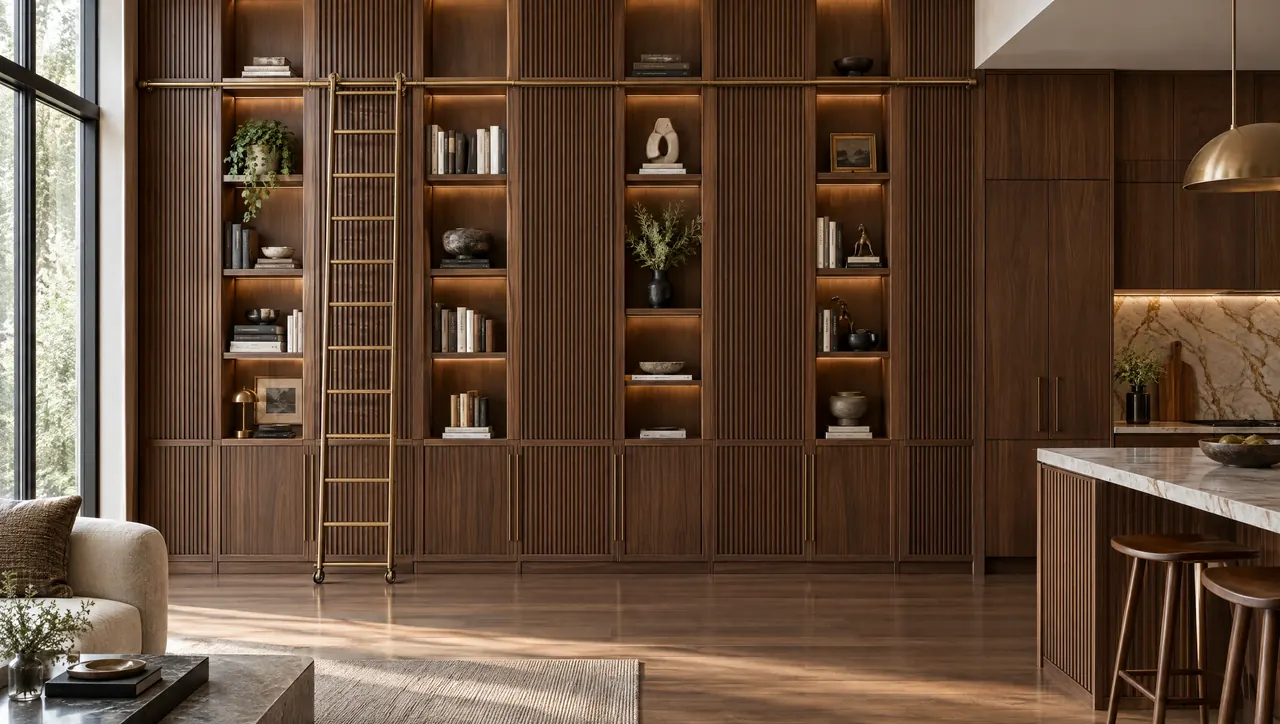
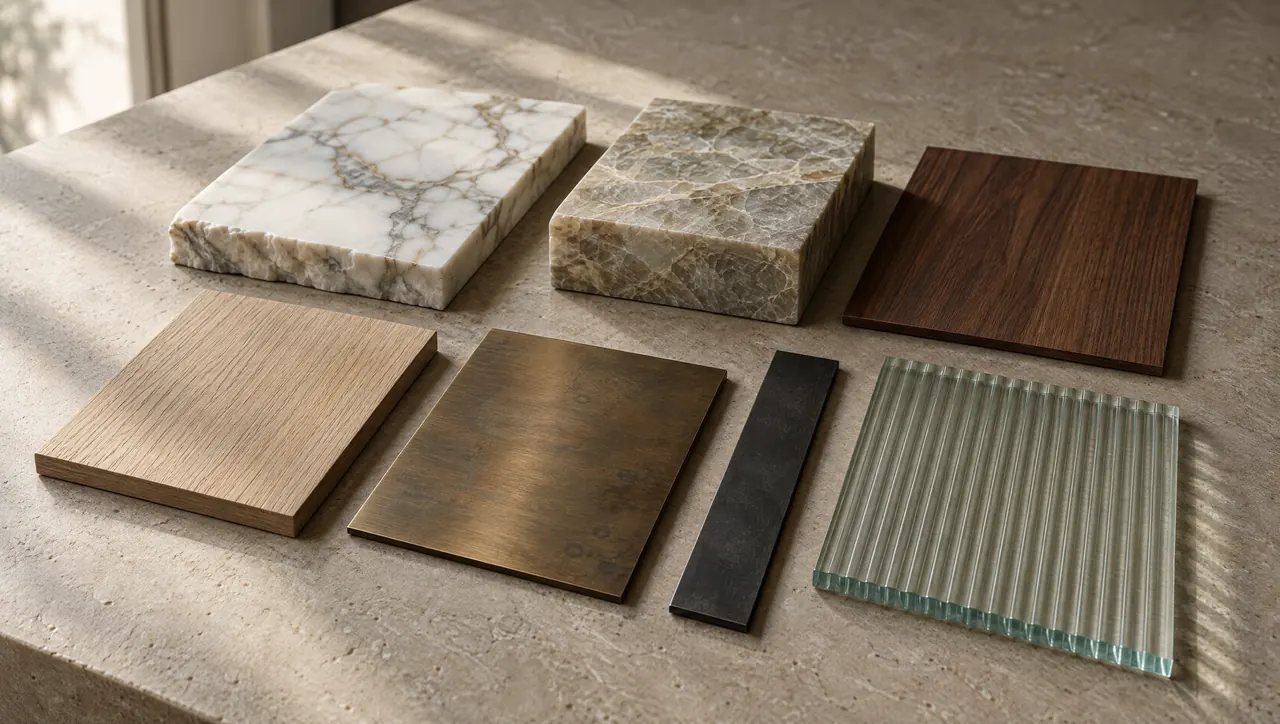

Wood cabinetry in a dry climate shrinks and swells with the air around it, and on the Front Range the driest stretch of the year begins now, when the furnace comes on. Good cabinetry is designed for that movement from the first drawing instead of trying to stop it.
Why heated winter air pulls moisture from wood
Wood is hygroscopic: it takes on and gives up water until it reaches a balance with the air around it. The USDA Forest Products Laboratory's Wood Handbook calls that balance point equilibrium moisture content, and it sets out how wood changes dimension as that content rises and falls.
Cold outdoor air holds very little water. When a furnace warms that air to room temperature, the water in it stays the same but its relative humidity drops sharply, because warm air can hold far more. Colorado's Front Range is semi-arid to begin with, so the air inside a heated house here in December and January is drier than most wood would ever meet in a coastal home. The cabinetry gives up moisture and shrinks. In spring, when the heat goes off and windows open, it takes moisture back and swells.
The movement is uneven. Wood changes very little along its length; nearly all of it happens across the grain. A wide board loses width while a long one keeps its length. Flatsawn boards also move more across their width than quartersawn or rift-sawn boards cut from the same log. Every decision in the table below follows from those two facts.
Wood cabinetry in a dry climate: what moves and what the design does
| Component | What happens in dry air | Why | Design response |
|---|---|---|---|
| Frame-and-panel doors | The center panel narrows. On painted doors a thin unpainted line can appear at the panel edge. | The panel is wide and moves across its grain; the frame around it is narrow and moves far less. | The panel floats in a groove without glue and is finished before the door is assembled. |
| Painted five-piece doors | Hairline cracks in the paint where rails meet stiles. | Rail grain runs at right angles to stile grain, so the two parts move in different directions. | Treat the line as normal seasonal movement, or choose a slab door on a stable core where a perfectly continuous painted face matters. |
| Wide flat slab doors | Cupping or bowing, and gaps between doors that open and close. | A single wide solid surface has nowhere to go but out of plane. | Wood veneer on a stable engineered core, veneered on both faces so the panel stays balanced. |
| Mitered corners | The joint opens at the outside edge. | Both pieces shrink across their width, which pulls the miter apart. | Reinforced miters and stable rift-sawn or quartersawn stock, or a veneered panel where the miter is long. |
| Solid wood tops and shelves | The piece narrows and can split if fastened rigidly. | Fixed screws hold the wood against its own movement. | Fasteners in slotted holes or clips that let the top slide as it moves. |
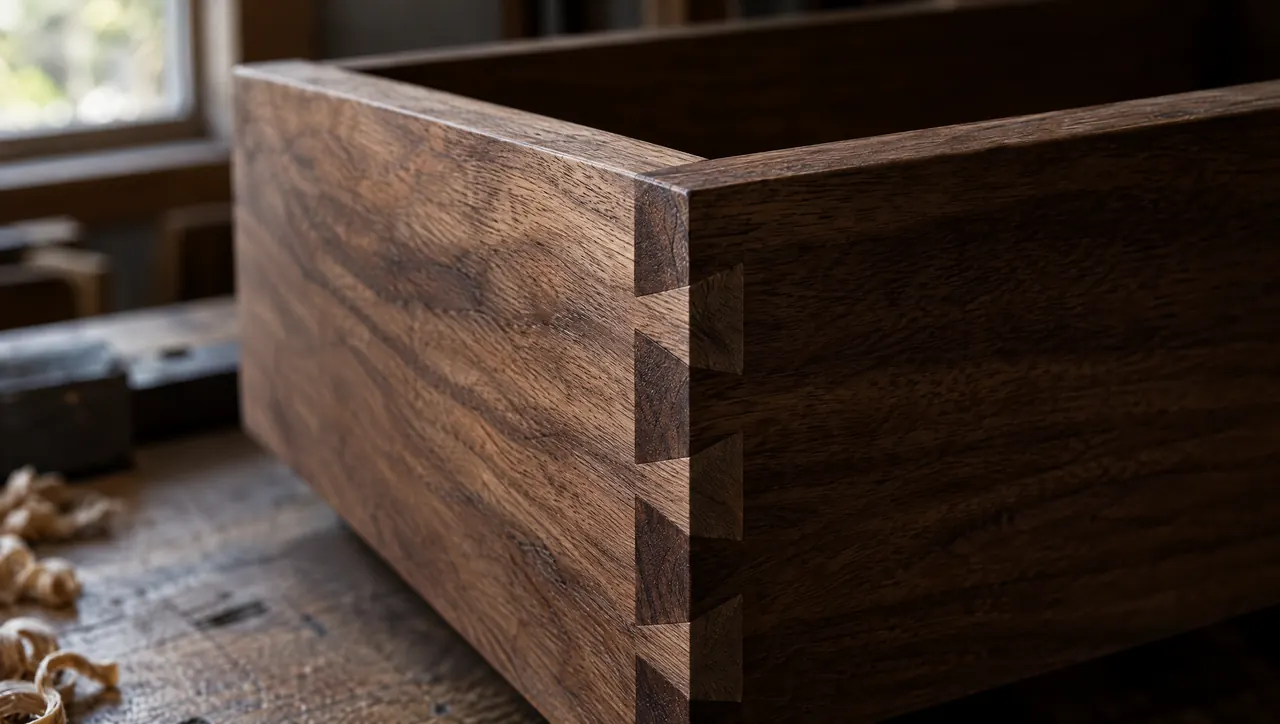
| Drawer boxes | A glued-in bottom can crack; the sides stay sound. | A bottom held tight at all four edges cannot shrink freely. | Dovetailed solid-wood sides with the bottom set in a groove and left free to move. |
| Panels beside ovens and dishwashers | More drying and heat stress than the rest of the room. | Oven heat, and steam released when a dishwasher finishes. | Clearances and shielding per the appliance installation instructions, and a moisture barrier under the counter above the dishwasher. |
The drawer box shown above is a small example of the principle. The dovetails hold mechanically, and the bottom sits in its groove rather than being glued tight, so the box stays square through a dry February and a damp May. We describe how we think about joinery and timber selection on our craft and materials page.
Decisions made before anything is built
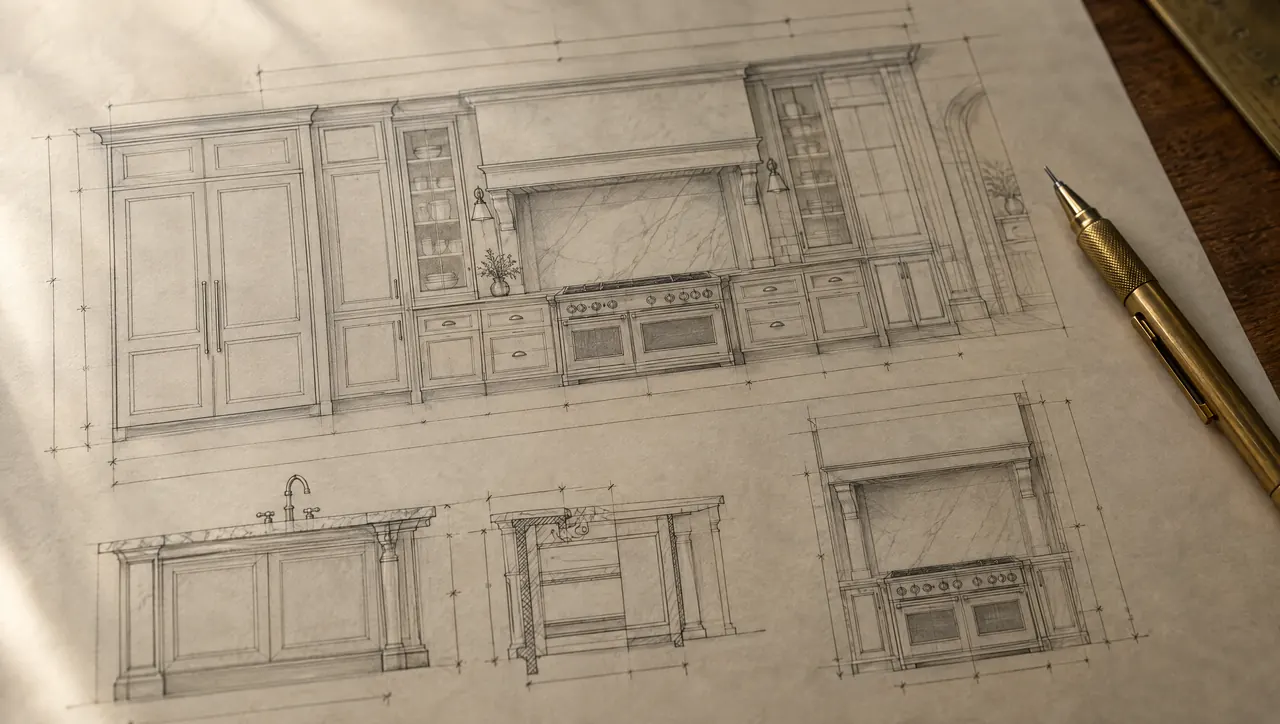
Most of the protection against dry air is settled during design. Species and cut matter: quartersawn and rift-sawn white oak are prized for stability, and choosing the cut deliberately is as important as choosing the species. Wide surfaces, especially bookmatched or continuous-grain fronts, belong on stable cores. Reveals between doors should be sized so they still read evenly when the wood is at its smallest. These are the details we resolve when drawing custom cabinetry and millwork, alongside the material specification for each surface.
If / then
- If you want painted cabinetry
- Decide early whether fine seasonal lines at five-piece door joints are acceptable. If they are not, specify slab or applied-molding doors on stable cores.
- If you want solid wood slab doors
- Keep them narrow. For wide or bookmatched fronts, we recommend veneer on a stable core every time.
- If the house is new construction
- Plaster, drywall compound, paint and concrete release moisture as they cure. Cabinetry delivered into that air and then hit by its first heating season moves more than cabinetry installed into a finished, conditioned house.
- If heat registers sit near cabinetry
- Work with the builder or mechanical contractor so supply air does not blow straight onto cabinet fronts or open shelving.
Site conditions and timing
The Architectural Woodwork Standards, published jointly by the Architectural Woodwork Institute and its Canadian and West Coast counterparts, set out a recommended relative humidity range for interior woodwork. Ask your HVAC contractor how your house will hold that range through winter, and plan for the heating and humidification to be running before cabinetry arrives. Raise it early, well before the Installation stage of our seven-stage process, so the cabinetry arrives into the conditions it will live in.
A winter care checklist
- Run humidification through the heating season and aim for steady conditions; a whole-house system controls this better than portable units.
- Avoid large, sudden swings, such as turning humidification off for a week and back on.
- Keep space heaters and direct register airflow away from cabinet fronts and solid wood tops.
- Open the dishwasher after steam has cleared, and wipe standing water from wood edges promptly.
- Refresh oil finishes on solid wood tops when water stops beading on the surface.
- Expect small seasonal lines on painted joints and leave them unfilled.
- If a door drifts out of alignment in winter, have the hinges adjusted; do not plane the door.
The bottom line
Put wide flat surfaces on stable cores, let solid wood float wherever it is used, and humidify the house steadily through winter. Cabinetry built and kept this way shows the season only in small, reversible ways.
If you are planning cabinetry for a house on the Front Range and want to talk through species, construction or site conditions, tell us about your kitchen and we will start from there.