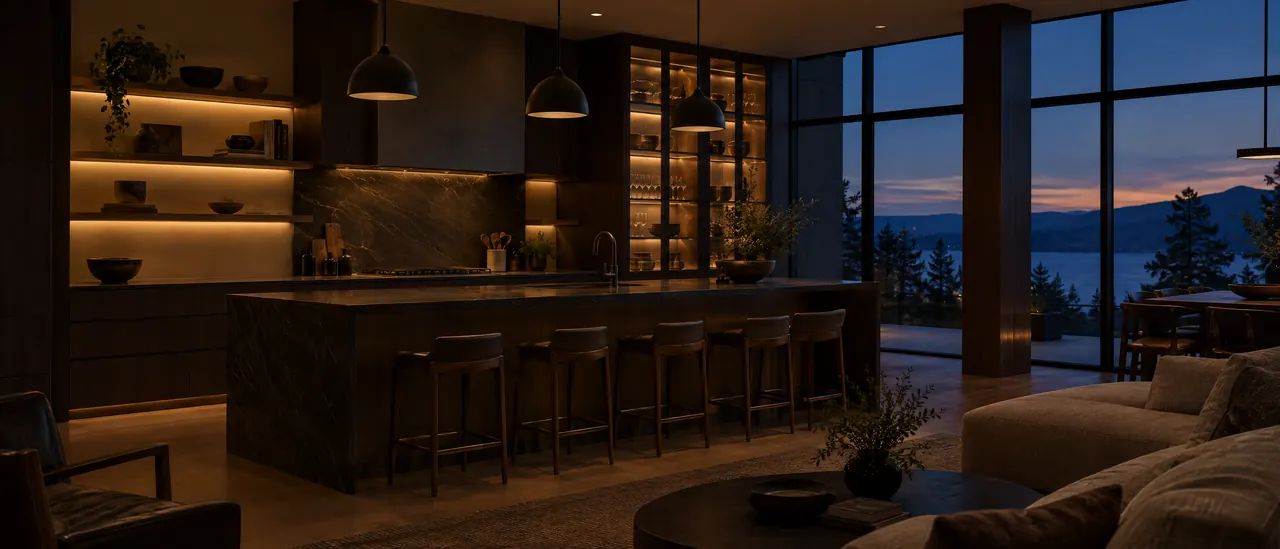
Most conversations about kitchen surfaces begin with appearance and end with a loose promise about durability. The useful questions sit in between: what acid, heat and years of cooking will do to the surface, and what shape its edge can take.
Know what each material is made of
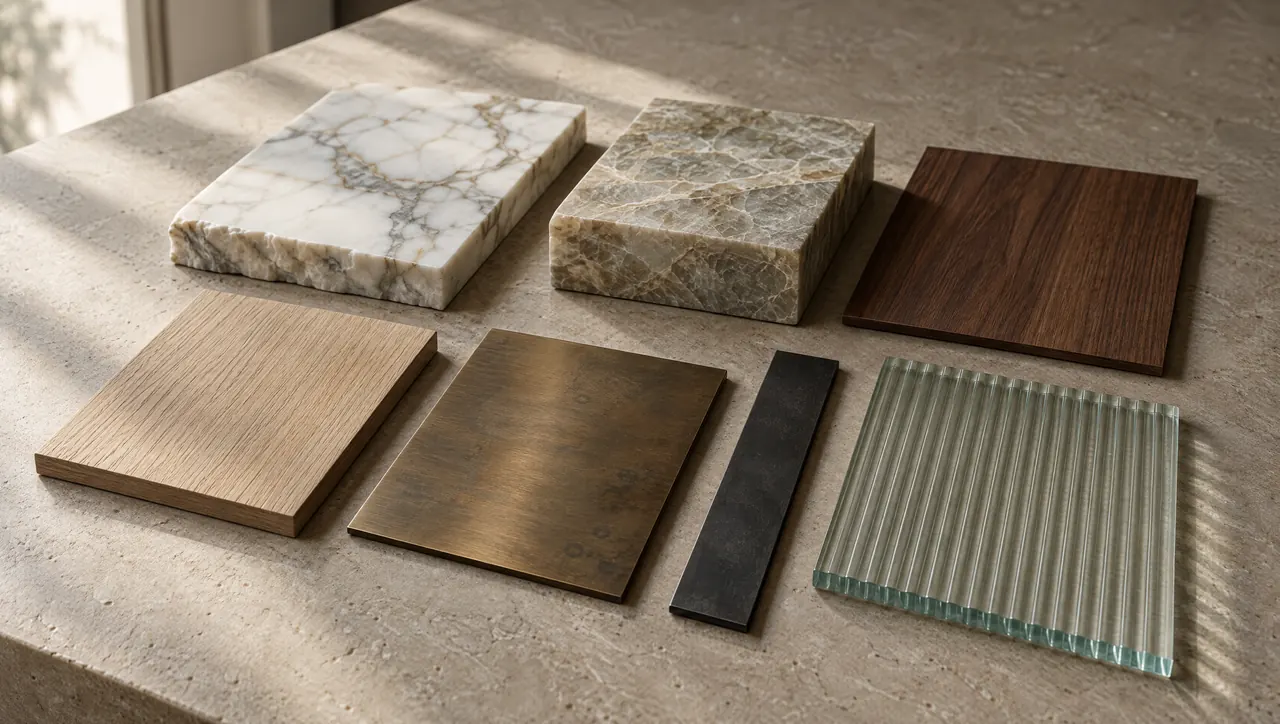
Natural stone is quarried, sawn into slabs, and behaves according to its geology. Marble, limestone and travertine are largely calcium carbonate, a mineral that reacts with acid. Granite is an igneous stone of tightly interlocking minerals, dense and hard. True quartzite is sandstone recrystallized under heat and pressure; it is mostly quartz and considerably harder than marble.
Engineered surfaces are manufactured. Engineered quartz is crushed quartz aggregate bound with polymer resin and pigment. Sintered stone and large-format porcelain are mineral powders compressed and fired at very high temperatures into a dense, nonporous slab. Their patterns are designed, so they are consistent, which is either the point or the problem.
Etching and staining are two different problems
Etching is chemical. Citrus, vinegar, wine or tomato reacts with the calcite in marble, limestone or travertine and dissolves a microscopic layer of the surface, leaving a dull mark. Staining is absorption: oil or pigment travels into the pores of a stone and darkens it.
The distinction matters because sealers address only one of them. A penetrating sealer slows absorption and buys time to wipe up a spill. It does nothing to stop acid reacting with calcite. A sealed marble counter will still etch.
| Material | Acid etching | Staining | Heat | How it ages |
|---|---|---|---|---|
| Marble | Etches readily | Porous; sealing slows absorption | Tolerant; trivets advised | Develops a soft patina |
| Limestone and travertine | Etches readily | Often more porous than marble | Tolerant; trivets advised | Softens and patinates |
| Granite | Highly resistant | Low to moderate; varies by stone | Very tolerant | Changes little |
| Quartzite | Resistant when it is true quartzite | Varies by stone | Very tolerant | Changes little |
| Engineered quartz | Resistant | Very low | Resin can scorch or discolor | Stays uniform; heat damage is hard to repair |
| Sintered stone and porcelain | Highly resistant | Effectively nonporous | Very tolerant | Stays uniform; edge chips are hard to hide |
Heat is where engineered quartz gives ground
A hot pan set down briefly is rarely a concern for granite or quartzite. Engineered quartz is different. Its resin binder is the weak point: sustained heat from a pan straight off the burner can scorch or yellow the surface, and that damage cannot be polished out the way some marks in stone can. Sintered stone and porcelain, fired at temperatures far beyond anything a kitchen produces, tolerate heat very well.
Fabrication raises a separate question. Cutting engineered quartz, and natural stones high in quartz, releases respirable crystalline silica dust, a serious occupational hazard. A responsible fabricator should describe their dust controls, including wet cutting, extraction and respiratory protection, without hesitation.
Edges and thickness are design decisions
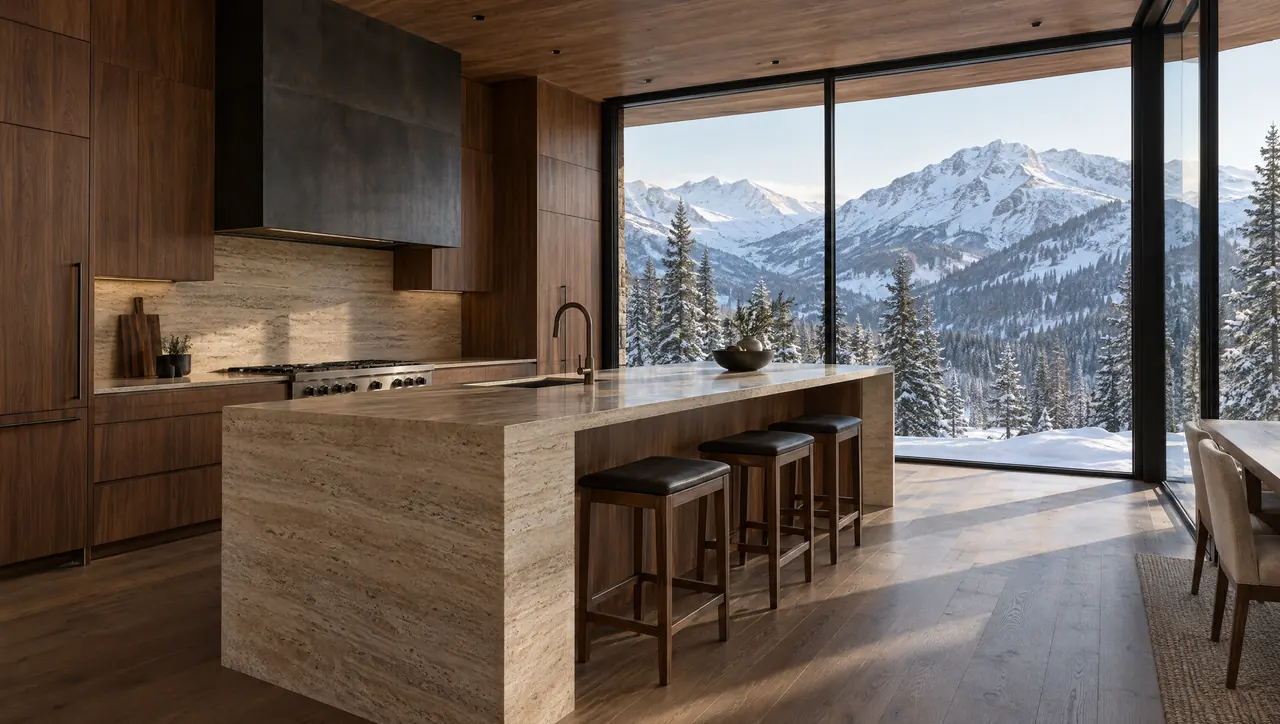
The edge is where a counter declares its thickness. Natural stone and engineered quartz are colored through the body, so they can take almost any profile: a crisp eased edge, a softened radius, a traditional ogee, or a deep mitered apron that makes the slab appear far thicker than it is.
Many sintered and porcelain slabs carry their pattern on the surface or only partly through the body. Shape the edge and the pattern may stop, exposing a plainer core. The usual answer is a mitered edge, two pieces meeting at a 45 degree joint so the face pattern wraps the corner. Done well, it is exceptionally clean. Done poorly, the joint shows from across the room, and a sharp corner on a brittle material is vulnerable to chips.
Bookmatching and slab selection reward patience
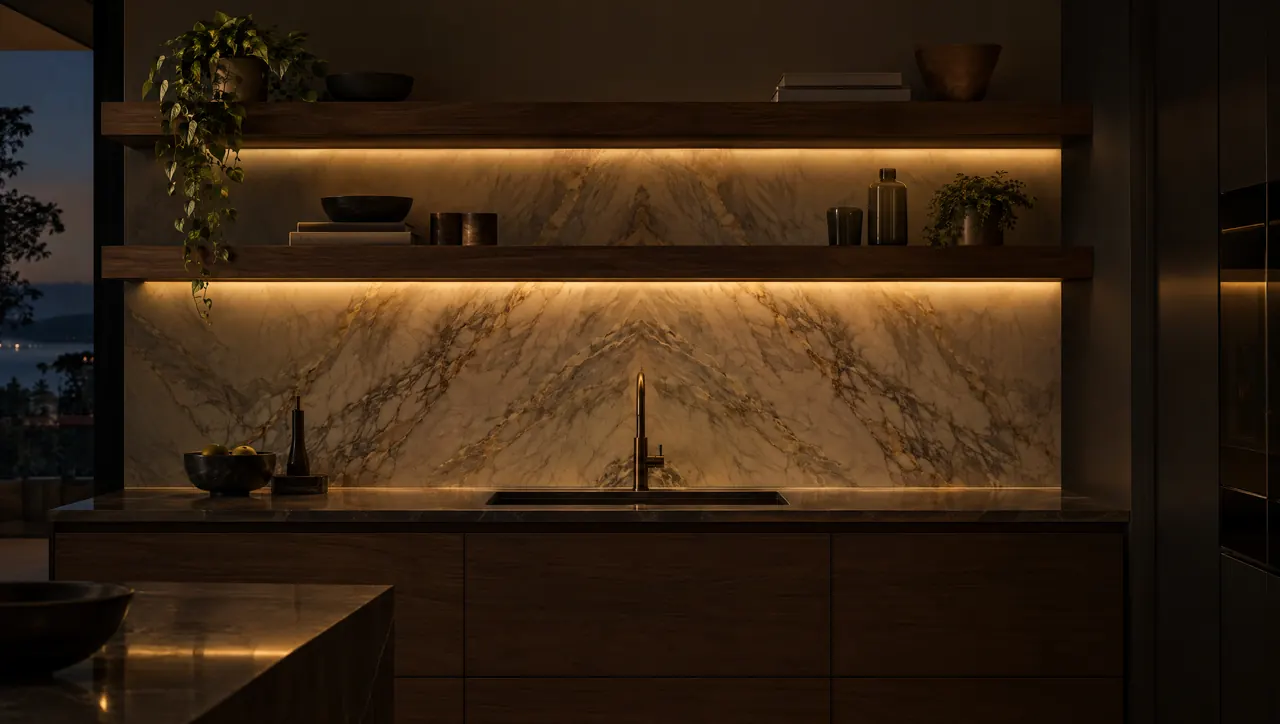
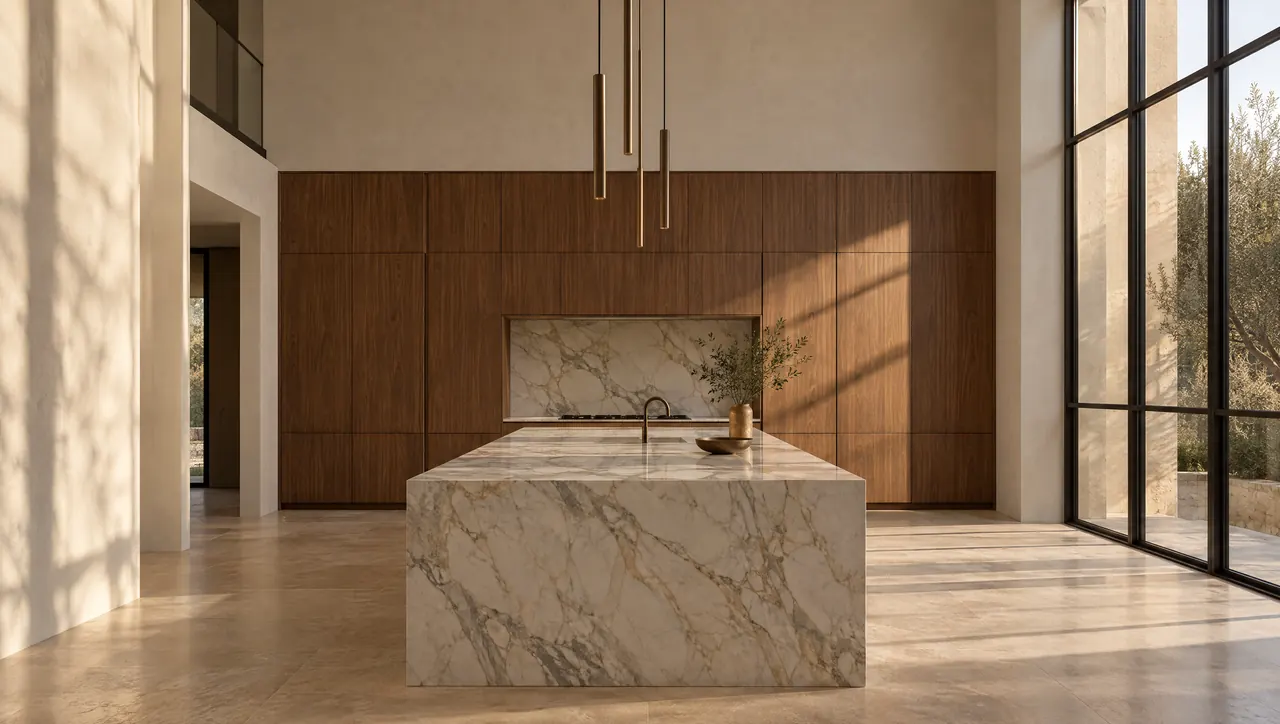
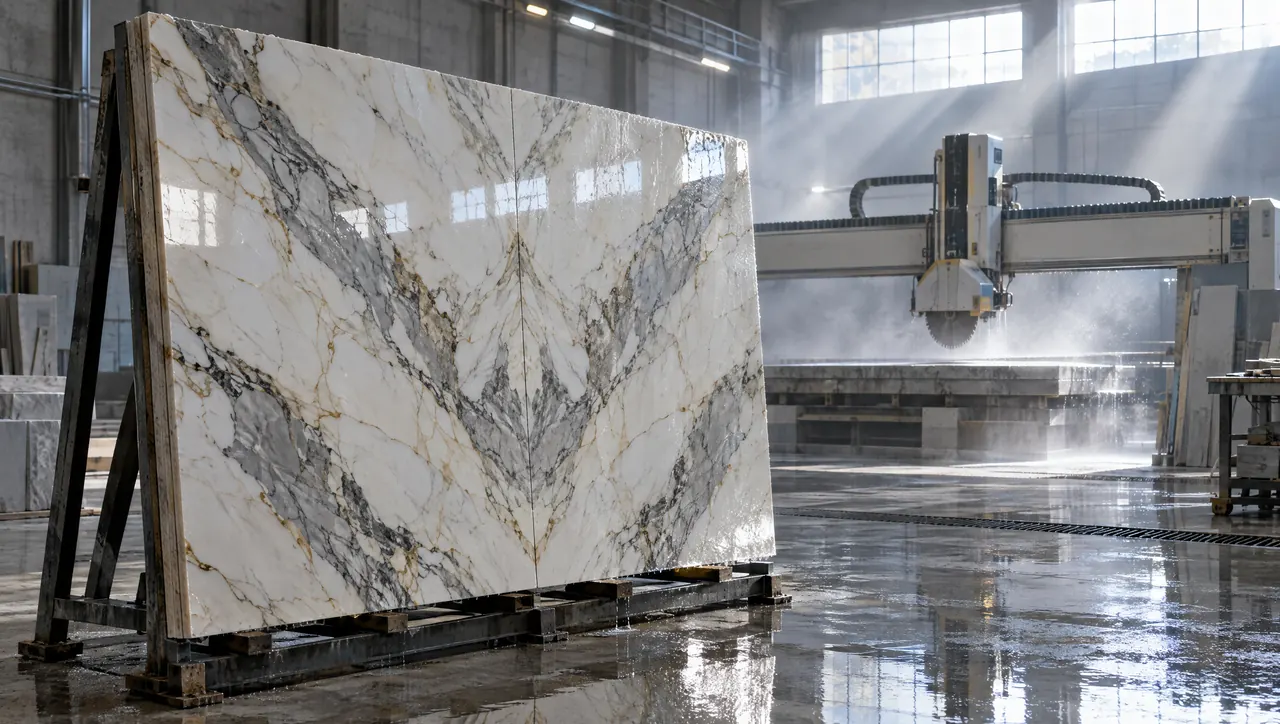
Bookmatching uses consecutive slabs cut from the same block, one turned over so the veining mirrors across the joint like the pages of an open book. On a backsplash or the waterfall end of an island, it turns a joint into the focal point of the room. It needs sequential slabs reserved together and precise alignment at the seam.
We specify natural stone after seeing the actual slabs, never from a sample chip, because color and movement vary from slab to slab within the same named stone. With engineered surfaces the pattern is manufactured, so the showroom slab is a reliable guide to the one delivered. Our material specification work begins with that distinction, and the same care for material runs through the craft behind each kitchen.
If / then
- If you want a surface that records use and softens with age
- Choose honed marble or limestone, and accept etching as part of its character.
- If you cook with acids daily and want natural stone that stays crisp
- Look at true quartzite or granite, and test the sample first.
- If consistency across a long run matters most
- Engineered quartz or sintered stone gives a predictable pattern.
- If hot pans go straight onto the counter
- Favor granite, quartzite, sintered stone or porcelain over engineered quartz.
- If the design calls for a thick, sculpted edge
- Use a material colored through its body, or plan a mitered edge from the outset.
Plan for how each surface ages
Marble and limestone change. Etches accumulate, sharp arrises soften, and the surface takes on an even patina. Etching shows far less on a honed finish than on a polished one, because there is less sheen to interrupt. For many people that patina is the reason to choose marble, as a well-used oak table looks better than a new one.
Engineered surfaces aim to look the same in year ten as on the day they were installed, and in normal use they largely do. The trade-off arrives with damage: a scorch or deep chip is hard to blend away, whereas natural stone can often be re-honed or refinished. Light shapes how all of this reads, which is why we consider how lighting changes a kitchen alongside the surface itself.
The bottom line
Natural stone offers individuality and a surface that can be refinished, at the cost of more care and, with calcite stones, inevitable etching. Engineered quartz offers consistency and stain resistance but less heat tolerance. Sintered stone and porcelain resist heat, stains and acid but limit edge detail. Choose by how you cook and how you want the room to age, then select the actual slab.
The most productive next step is to look at real slabs with a specific room and way of cooking in mind. We are glad to talk through the options with you. Get in touch to arrange a consultation.